Showing posts with label empowering. Show all posts

Wednesday, December 23, 2009

Training and rewards, Santa style


The connection between behavior and rewards is simple, if you're talking about Santa. You behave, you get toys. You misbehave? You can look forward to a stocking full of coal. Nasty.

The really cool thing about that plan is that it is clear and up front. No mysterious stockings full of coal because some bean counter said there where too many good children. The terms are clear...clean your room, help out mom and dad around the house, brush your teeth, and you're pretty much guaranteed that old Saint Nick won't leave you lumps of fossil fuel instead of a candy cane and toys.

Wouldn't it be great if corporate training worked that way? Or heck, corporate life in general.

Imagine this:

You come into work every day, you work hard. You do your reports and track your products. So when training opportunities come around, you can pretty much count on a sweet opportunity to learn something new, improve your skills, maybe get set for a promotion when a position opens up.

Sorry. The reality is far from the Santa-based system. We treat employee training like some secret formula we need to protect from the masses.

First, we limit the number of people who hear about the training being offered. It becomes something more like an invitation to a secret society than a chance to create a better educated workforce.

Then, we have an approval process for people who "heard" about the training and want to go. We screen them to make sure we only allow in those who already have jobs related to the training. The idea that others in the organization might benefit from diverse training is about as accepted as the idea of little green men -- we all know about the stories, but no one in their right mind would admit to believing them.

Finally, we make it hard to people to attend the training. In many organizations, salaried employees attending training are expected to do their normal job on their own time, outside of the training time. Now there's a big incentive, right?

There are literally millions of pages of research showing that a better trained and cross trained workforce is more productive, more committed and more successful. And yet, and yet...the stocking full of coal continue.

Can we take a page from Santa in 2010? If your employees are on the nice list, make training one of their rewards? At the very least, it beats vacuuming up all that coal dust.

Tuesday, February 17, 2009

Can you train yourself to be happy at work?

You can train for a marathon, you can train employees to follow safety rules at work, but is it possible to train yourself to be happy at work?

Karl Staib, author of Work Happy Now!, believes that by eliminating complaining out of your day it can force a positive change in your life and at work.

Karl recently signed himself up for a personal “No Complaining” 30-day challenge and discovered how putting situations in a positive light had the power to change attitudes of people around him, as well as his own attitude.

He explains how it basically comes down to how you phrase things:
“I might say, “I don’t feel like going to work today. I’m tired. My job doesn’t give me any incentive to work hard.” This is just whining. If I rephrase it and say, “I’ve been working really hard on this project and I need a break.” Then we start to turn the complaining into something more positive. If I rephrase it again and say, “Going to work is probably not the best choice for me right now, but I need to work on this important project.” Then we get into more of a “sharing complaining” territory.

You could say in a boisterous voice, “I’m going to work today and even though I’m tired, I’m going to accomplish great work.” It doesn’t sound so much like complaining, but reinforcing a positive state of mind. We all know it’s still complaining, but it’s a lot easier to handle for the people who have to listen.”

He followed two methods to reduce complaining:

1. If you complain about something, redirect your thoughts to something positive.

Instead of saying, “Arrgh, why do I have to do this report over? I wish they would make up their minds.”

Say, “Okay, they might not be right, but I don’t know all the reasons behind their decisions. I’ll redo this report and also take mental notes on how I would handle this situation. When I become an owner/manager I won’t make the same mistakes.”

Understand that the experience, whether positive or not, can be used to improve our skills. Looking at it in a positive light makes you feel like you have control over the situation where you may have felt powerless before.


2. Rephrase the complaint before you say it.

You’re thinking, “Arrgh, why do I have to do this report over?”

Rephrase that thought by saying, “Hmm, it’s interesting that they want me to do this report over.”


Flipping the complaint into a positive statement or rephrasing it can mean the difference between having a horrible day or a great one. Finding a way to enjoy the situation, even if it’s not how you originally intended it to turn out, will help you have a better day and be happier at work.

Here’s how Karl sums up his 30-day “No Complaining” challenge:

“No Complaining” for thirty days made me aware of many areas of my thoughts and emotions that were invisible before this challenge. This month has given me the most personal improvement I’ve seen all year. It helps to take a microscope to your inner thoughts. I’ve taken my work happiness to a whole new level.


Read more about Karl’s “No Complaining” challenge at Work Happy Now!

So, do you think you can train yourself to be happy at work? Do you think it’s a worthwhile experiment to try?

Thursday, January 29, 2009

Should employees choose their own training?

Yesterday, Jim Giuliano at HR Morning shared one of his best HR management ideas: let employees find and choose their own training.

The idea became a winning solution to one company’s struggle to find new employee training ideas with limited resources, a common challenge many small companies face.

You can read the longer version at HR Morning, but here’s the basic story:
  • During the recruiting process, people are told that the company is dedicated to continual learning and development, using training to reach career goals.
  • Supervisors and HR don’t have enough time to come up with new training ideas relevant to the goals of the employee and company.
  • The company can’t afford to hire a professional training coordinator.

Solution: Turn employees into their own training coordinators.

Employees find and choose their own training, under two conditions:
  1. They must prove that the training correlates with their jobs and careers.
  2. The cost of the training program must be justified (increased cost, increased benefit).

The company tried out the program for one year on an experimental basis with only a few employees.

Results were mixed: “Not all employees embraced the idea - some still wanted the supervisor to pick the training. But we found that the ones who did take control of their training often also happened to be our most motivated, top performers.”

Why it’s a great idea:
  • It improves employee engagement by giving them the freedom to choose which areas they would like to improve on.
  • It saves supervisors and HR time by having employees take over the task of researching new training ideas.

But what do you think?

Are you struggling with finding new ideas for employee training and think a program like this could work at your company? Should employees choose their own training? Could it cause any problems?

Wednesday, September 24, 2008

De-stress at work and encourage innovation

The economy is in bad shape. So bad even Warren Buffett is worried.

Whether its the falling dollar, gas prices or debt, our country’s financial problems have all of us pretty stressed out these days. Aside from some of the more violent effects of a bad economy on the workplace, stress has a direct impact on employee productivity and your bottom line.

According to the 2007 “Stress in America Report” by the American Psychological Association, more than half of Americans said they are less productive at work as a result of stress.

From Entrepreneur.com:

“All that stress adds up to an estimated $300 billion a year in costs for U.S. businesses due to absenteeism, decreased productivity, employee turnover, and medical, legal and insurance fees.”

On top of the economy, the bleak medical benefits situation in the US is stifling innovation. As medical premiums and medical deductibles rise, more money is taken out of paychecks and people have less money to spend. Innovation is difficult to find when employees are overwhelmed with medical bills.

While we can’t change our country’s health care system or improve the economy overnight, we can do something to help lessen employee stress at work. Get their minds off their finances and focused on innovation, and you’ll start seeing happier, more productive employees with better ideas coming out of your company.

A few ideas to de-stress employees and spark innovation:

Start a Fantasy Football league. It’s helped some big companies like NuVox motivate their staff and build teamwork. Some friendly office competition that doesn’t take employees away from their work for too long can help alleviate stress.

Start a skunkworks program or innovation league. It’s hard to get businesses to take risks in a bad economy. Sideline any fear of risk and start a company within your company (called Skunkworks) where innovation is encouraged. Once all of the “real” work is done, get together with the skunkworks team to innovate and empower employees. It can be as little as four hours a week, or more depending on how much time is available.

Start an employee wellness program. Regular exercise improves health and reduces stress. Start a weekly walking program or make a deal with a local gym for discounted employees memberships, and get employees moving. Healthier employees make less trips to the doctor, reducing medical costs and insurance rates.

Start telecommuting. Allow employees to telecommute for part of the week. Just reducing an employee’s weekly commute by one day can make a big dent in how much they spend each month in gas. By spending less money commuting to the office, employees will have one less thing to worry about financially.


Unless you have $800 million in your back pocket, no one is going to solve the nation’s financial crisis anytime soon. Until the economy begins to turn around, all we can do is work to mold company cultures to help de-stress employees and encourage innovation.

Thursday, September 18, 2008

Employee engagement drives loyalty, retention

Employers that focus on employee engagement and encourage creativity will attract high-performing job candidates and retain loyal employees, giving their company the competitive advantage, according to a new survey by IMR Research Group.

“Business leaders are now recognizing the role employee engagement and loyalty plays in the financial health of a company,” Stacey Randall, IMR’s workplace futurist, said in an IMR story.

“Employee engagement directly impacts profitability and you are wasting resources – human and financial – unless you are focusing on the policies and practices that are going to give you the most bang for your buck.”


Survey results revealed that the workplace attributes with the greatest impact on employee loyalty and retention are:

  • Trust between managers and employees
  • Influence on goals and strategy as they relate to the job
  • Opportunities for professional development
  • Employee empowerment for decisions
  • Encouragement of creativity
  • Passionate and motivated employees


Keeping employees engaged and management focused on the key factors affecting loyalty, will increase job satisfaction and decrease the number of employees searching for opportunities elsewhere.

“The future of the American company rests on our ability to innovate, and workers understand how brainstorming and other creative thinking sessions can contribute to the company’s bottom line as well as make employees feel their input is valued,” Randall said.

“This study indicates that these attributes are not standouts in employees’ minds, but efforts to improve in these areas can lead to great results.”

Friday, September 12, 2008

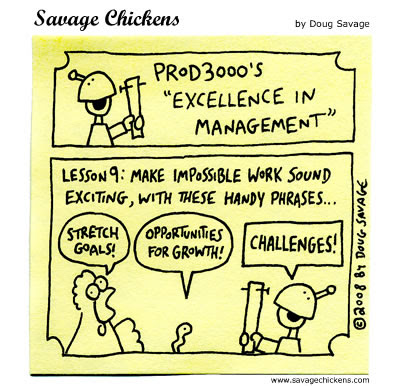
Friday office humor: Top 3 motivational phrases

After you have a clear understanding of what motivates different generations in the workplace, fire up your team with encouraging communication.

Excellence in Management Lesson Number 9: Make impossible work sound exciting with these handy motivational phrases ...

Stretch goals!
Opportunities for growth!
Challenges!

Special thanks to Savage Chickens Excellence in Management.

Monday, August 4, 2008

Dancing improves employee productivity

Do you wish your company buzzed like a hive of bees? Everyone productive, industrious, organized?

The beehive is “the very model of business,” according to Benjamin Ellis at Redcatco. Before achieving any business success, you must first give your bees some free time and room to dance. Dancing is the key to improve employee productivity.

Ellis explains how even though it may look like bees never take a break from work, they actually spend a significant portion of their time wandering around the hive and dancing with their coworkers (fellow bees).

For parts of the day, bees travel aimlessly in hopes to stumble upon nectar, the sugar source for honey. When a bee comes across a fruitful patch, it returns to the hive and does a “waggle dance” for its coworkers demonstrating where the nectar is. The coworkers quickly get moving to collect the rest of the discovery.

“It is a process of innovation and discovery. A single bee, with the time to wonder, makes a discovery. It then shares the discovery with the hive. The process maximizes the return on the new discovery, while minimizing unfruitful searching by other bees.”

So, Ellis asks: “Do your employees dance?”

Like we said last week, give yourself and your employees time to be creative, time to wander in search of nectar. Energize your hive with just a little bit of free time and you may find some sweet success.

Friday, August 1, 2008

Schedule some time to think

Do you ever take a minute to just sit down and think? No Internet, no phone, no iPod, just you and your brain.

It’s a question Chris Morgan from Learn2Develop asked earlier this week, that got me thinking. When does anyone have time to just sit down and think?

In today’s world, our schedules are crammed back-to-back with meetings and deadlines, with hardly enough time to grab “lunch” from the vending machine.

It turns out some very smart (and busy) people have figured out how to fit thinking in daily. Barack Obama, Leonardo DaVinci and MindMap inventor Tony Buzan all take thinking pretty seriously.

"The most important thing you need to do is to have big chunks of time during the day when all you're doing is thinking," said Obama in a recent BBC article.

Innovative companies including Google and 3M allow employees to set aside 20% of their time to think and work on projects not immediately connected to core business goals.

If you think giving away free time will have employees playing video games and shopping online for shoes, think again - 50% of Google’s latest features were thought up during employee “free-time.”

“Aspiring innovators don't need pep talks. They need TIME. Time to think. And time to dream. Time to collaborate. And time to plan. Time to pilot. And time to test. Time to tinker. And time to tinker again,” says Mitch Ditkoff at The Heart of Innovation.

So, block out a little time on your schedule today for a meeting with yourself, a meeting just to think. Ready? All together now ... ohmmm ...

Monday, July 21, 2008

Share the lead for successful teamwork

So, you put together a team to address the latest problem at hand and now you’re wondering who to put in charge. If you want the group to be effective, you won’t put anyone in charge.

At least that’s the latest teamwork advice out of the Wall Street Journal (WSJ). Their researchers found that teams are the most successful and productive if leadership is shared among team members.

“Our research, in fact, suggests that teams that perform poorly tend to be dominated by the team leader, while high-performing teams have a shared-leadership structure,” according to the WSJ.

Generally, teams in a work environment are set up to follow the long-standing model where one person in charge and everyone else falls in line. But, the latest research flips that idea upside down.

When you a team who specialize in the different, the collective knowledge will be greater than having one individual leader running the show. With shared leadership, team members step-up when their specific expertise is needed.

It’s an innovative approach to developing successful work teams, but one that’s also worth a try. The WSJ studied dozens of teams in a variety of industries and found that shared leadership led to the best results.

Like everything, shared leadership does have some drawbacks. The practice is most successful when teams have had time to develop, have a good sense of each person’s strengths and know when each person should be in charge.

Strong personalities may also hinder team success. When team members get too pushy or don’t have the confidence to lead, the shared leadership technique can easily fail. Team members must also have the proper management skills to lead one another successfully.

“Instead of seeing the matter as a black-and-white choice, companies should ask some simple -- but crucial -- questions. When is it a good idea to share the reins? And if we do decide to go that route, what steps can we take to make sure we're ready? Companies that apply shared leadership judiciously can see tremendous gains.”


Read the full WSJ article.

Monday, June 16, 2008

The one thing young employees want at work

No, it’s not a Xbox or Wii in the office - they just want their opinion heard and valued.

During a webinar on the recently released report, Ready to Lead? Next Generation Leaders Speak Out, one older caller asked “What is one thing Millennials want, to feel better at work?” The first thing that popped into my head was “Ask for my opinion, and when you do at least consider it.”

The above quote is from Social Citizen, a blog by Tera Wozniak, a self-defined Millenial and nonprofit professional who offers great insight into the mind of the young professional.

Recently the editor of the Harvard Business Review asked the same question - “Are You Underutilizing Younger Employees?”

At a post-conference cocktail party, the HBR editor realized he may be too quick to overlook or dismiss smart young professionals. After listening to the opinions of young professionals from a variety of fields, they all shared the same desire - to be heard.

Allowing younger employees to enter conversations and have their comments validated can do wonders for their career confidence. With more confidence in their ideas, a Generation Y employee will feel more inclined to share their opinion in other areas of their work. It also allows the employee to learn valuable problem solving techniques of experienced employees.

So, adding to the list of what Gen Y wants from their employers, add “being heard” to the list. Along with ongoing recognition and flexibility, being a part of workplace conversations is a top priority.

Thursday, April 24, 2008

Employee recognition ideas that don’t work

“Never give a plaque to an employee who has no wall!”

This quote from Anne Bares at Compensation Force sheds light on something important to remember when coming up with new employee recognition ideas - it doesn’t matter what you think is a great gift, give employees what they would most appreciate.

In one of our past posts, we mentioned that younger Gen Y employees would much rather have a gift card to their favorite store or a pair of movie tickets over a shiny silver “You’re #1” award pin.

An unfitting employee recognition award can actually have a negative outcome. A boss may think they’re giving a wonderful gift to an employee, but that same employee thinks the gift is old fashioned and that their boss doesn’t care.

Recognition needs to be tailored to the employee who is receiving it. Don’t assume someone will like a gift based on what you think is nice. The solution is simple - just ask your employees what they would most like to get.

Bares shares a great lesson:
Recognition can be a powerful and effective tool, particularly given its ability to accomplish a lot on a relatively small budget. But recognition plans can have extraordinarily limited shelf lives. You have to keep 'em fresh and keep 'em real, and you have to watch carefully for signs that they are fraying around the edges.
So keep it fresh, keep it real and keep on showing employees they're appreciated.

Monday, March 31, 2008

Stephen Covey's "emotional" work habits - Part 2

After learning what the emotional bank account is and how to make deposits and withdrawals, Stephen Covey’s next step to master the 7 Habits of Highly Effective People is adopting a win/win mindset.

There are certain skills and attributes needed to achieve the win/win mindset. It starts with character - the measure of your personal integrity, maturity and an abundance mentality.

Integrity - can others count on you to do what you said you would?

Maturity - having the courage to stand up for your principles and respect others’ principles.

Abundance Mentality
- believing that there is plenty of success to go around.

Applying the win/win mentality:

Incorporate it into your weekly plan. When you have a task for someone (or you’re given a task) make sure you clarify the desired results, know the guidelines, define who is responsible for what and clearly outline the consequences of not living up to the agreement.

Commit to the “Abundance Mentality.” Your success does not take away from someone else’s success. The same holds true on the flip-side. Don’t think that someone else has succeeded at the expense of your own. Teamwork will create even greater success that what can only be achieved by an individual.

Teach the mentality to another person. One of the best ways to retain information is to verbalize it to another. Find someone close to you and teach them about the Abundance Mentality. It would be a great way to start contributing to their emotional bank account.

Wednesday, March 19, 2008

Training the trainer: Tips for public speaking

Are you the leader of an upcoming presentation or training seminar? Does it make your palms sweat just thinking about speaking in front of a room full of people?

A trainer or presenter is only as good as their communication skills. Here are a few tips to overcome your public speaking jitters:
  1. Practice on small groups of people. Round up some friends or family members and practice your speech on them.
  2. Make sure you’re prepared. Do the research and know your facts. You’ll feel more confident when you know your stuff.
  3. Don’t memorize the material. Remember key topics you want to cover, and let that drive your presentation.
  4. Avoid slides. Don’t put your audience to sleep with a never-ending slide presentation. If you must have slides, use them mainly for visuals that help get your core message across.
  5. Don’t stress out. Easier said than done? Try some deep breathing and visualize a positive outcome.
  6. Make friends. Take a few minutes while people are entering the room to shake hands and personally introduce yourself to some people.
  7. Engage the audience. Incorporate two-way communication with questions and come up with a creative way for your audience to participate.
Practice some of these tips and good luck at your next presentation!

Steve Jobs Stanford Commencement Speech 2005

Maybe if we as HR managers, trainers or other kinds of leaders could help people find their path...or maybe just give them the freedom to do so, the results for everyone...the individual, the company, the country, the world...would be far more than we could imagine.

Instead, we focus on shaping, teaching at, directing, controlling -- and very seldom on inspiring or empowering. Almost never on creating a place for taking chances and learning what we COULD do.

Watch this video, listen and think. What could we do differently as trainers to achieve a better result?


Brought to you by www.gneil.com