Showing posts with label brainstorming ideas. Show all posts

Tuesday, June 9, 2009

Do not disturb: Daydreamers hard at work

The next time you walk by Bob’s desk and see him staring into space, daydreaming about his summer plans, you may want to think twice about telling him to snap out of it and get back to work.

What looks like lazy daydreaming on the outside may actually be a sign that Bob’s brain is busy finding the solution to a difficult problem.

New research out of the University of British Columbia suggests that our brains are still hard at work while we daydream. The study found that activity in numerous areas of the brain increases when our minds wander. Researchers also discovered that the problem-solving areas of our brains, once thought to stay dormant while daydreaming, are actually highly active during such episodes.

"Mind wandering is typically associated with negative things like laziness or inattentiveness," says lead author, Prof. Kalina Christoff, UBC Dept. of Psychology. "But this study shows our brains are very active when we daydream – much more active than when we focus on routine tasks." (Science Daily)

“One of the things that I hope might come out of our study is that people realize that their brains are definitely not getting shut down when they mind-wander,” she said. “They’re very active….You have this unique brain state where instead of having one or the other shut down, both networks are available to be used. It’s a mental state that’s really not lazy, from the point of view of the brain.”

That may be why it seems as if many people’s best ideas come from inadvertent straying of the mind.” (Ubyssey Online)

So, the next time you have to solve a difficult problem or come up with a creative idea, sitting down and aggressively thinking about it could be the least effective way to find a solution.

As the research suggests, it might be best to let yourself work on a simple task that gives your mind room to wander. You may be surprised with the creative ideas your mind comes up with while you were daydreaming.

We’ll leave you with a quick clip from a commercial you’ve probably seen before. But this time, the practice of “ideating” may not look like such a bad idea. Take a look:

Monday, December 8, 2008

Six-word icebreakers, keep it short

When Ernest Hemingway was challenged to write a story in only six words, he responded with:

“For sale: baby shoes, never worn.”

SMITH Magazine reignited the six-word story challenge in 2006 by asking readers to describe their lives in six words or less. The response was so overwhelming that they compiled the stories and created a book, Not Quite What I was Planning: Six Word Memoirs from Writers Famous and Obscure.

“They sent in short life stories in droves, from the bittersweet (“Cursed with cancer, blessed with friends”) and poignant (“I still make coffee for two”) to the inspirational (“Business school? Bah! Pop music? Hurrah”) and hilarious (“I like big butts, can’t lie”).”


The six-word memoir is not just a lesson in writing, but a concept that can be used to stay on task and on time around the office.

Take the idea of the six-word memoir and turn it into an introduction game or icebreaker:

  • As everyone takes a seat at your next meeting or training exercise, tell them they have two minutes to write down their job description only using six words. When the two minutes are up, go around the room and have everyone share their name and six-word memoir.

Or, use it to keep your brainstorming sessions focused and to the point:

  • Inspire your group with this video from SMITH Magazine and then ask the group to come up with ideas that can be written in six words or less. Whether you’re brainstorming new slogan ideas or identifying core issues, keeping ideas under six words will keep everyone focused.

Saying anything in six words or less can be a challenge, but it’s an exercise that delivers a great lesson on the value of clear communication. Use the ideas above or create your own six-word activities to challenge your next training group.

Have any ideas on how to use the six-word challenge to inspire employees? Leave a comment and let us know.

Monday, September 8, 2008

Laughs and leadership advice at the carnival

Vice-president hopeful Sarah Palin has her work cut out for her in the next few months. With the media and opponents criticizing her lack of leadership experience, she’s lucky to have a friend out there like Dan McCarthy.

McCarthy went out of his way and put together a slew of leadership development advice for the vice-president hopeful in the latest edition of the Leadership Development Carnival.

Though the carnival may be dedicated to Sarah Palin, the featured attractions, side shows and expert leadership advice are worth the trip. With regards to leadership training, we made it easy and picked out these featured posts for you:

Like we’ve discussed before, employee recognition in small packages can have better results than other big-ticket items. “It’s more likely to be the small and personal moments that really shape our lives,” according to the Happy Manager’s leadership philosophy.

While employees understand they are accountable for “taking initiative and bringing about change,” only 40% of employees believe they have the power to make a difference. Art Petty examines the root causes and cures for disconnected organizations in “Do Your Employees Truly Believe That They Can Make a Difference.”

Understanding that “what gets measured gets done,” Chris Young at the Rainmaker Group, advises using coaching score cards to improve employee performance. Score cards can outline exactly what is expected of employees and help determine if an employee’s position is a bad fit.

Though our brains may be aging, they continue to develop and learn well into old age through a process called Neurogenesis. Laurie Bartels at The Brain Fitness Authority examines Neurogenesis and Brain Plasticity in Adult Brains and how we can use it to better understand how aging brains learn.

Why do some people seem to have all the motivation in the world and others have none? Dawn Abraham Life Coach examines new motivation ideas and shares a few secrets on how to motivate others and yourself.

Those at Invent Creativity examine the top 10 mistakes while brainstorming, including mistake number five - allowing an untrained facilitator to lead a session.

Monday, August 25, 2008

Dabbleboard: New online collaboration tool

Want to think and communicate visually with remote employees? Try Dabbleboard.

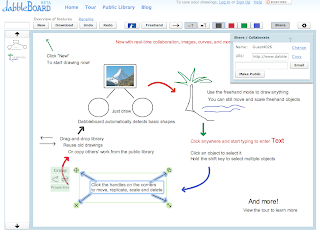
Dabbleboard is the latest online whiteboard tool helping teams communicate and share ideas from anywhere in the world. While there are other digital whiteboards out there, the biggest perks with Dabbleboard are how clean drawings come out and the ability to collaborate in real time.

Since most of us are very unskilled when it comes to drawing with a mouse, Dabbleboard recognizes common shapes (circles, lines, boxes, etc.) and redraws them neatly. Real-time collaboration makes it simple for multiple users to be in the program and drawing at the same time.

Dabbleboard produces attractive and easy to share documents. You can type and insert images anywhere on the board, stop working at any time and continue the drawing later by saving it for private or public use. Drawings can be emailed, downloaded in PNG format, or easily shared by sending a URL.

The coolest part - it’s free. So, take the tour and give it a try.

Dabbleboard online collaboration tool

Friday, August 1, 2008

Schedule some time to think

Do you ever take a minute to just sit down and think? No Internet, no phone, no iPod, just you and your brain.

It’s a question Chris Morgan from Learn2Develop asked earlier this week, that got me thinking. When does anyone have time to just sit down and think?

In today’s world, our schedules are crammed back-to-back with meetings and deadlines, with hardly enough time to grab “lunch” from the vending machine.

It turns out some very smart (and busy) people have figured out how to fit thinking in daily. Barack Obama, Leonardo DaVinci and MindMap inventor Tony Buzan all take thinking pretty seriously.

"The most important thing you need to do is to have big chunks of time during the day when all you're doing is thinking," said Obama in a recent BBC article.

Innovative companies including Google and 3M allow employees to set aside 20% of their time to think and work on projects not immediately connected to core business goals.

If you think giving away free time will have employees playing video games and shopping online for shoes, think again - 50% of Google’s latest features were thought up during employee “free-time.”

“Aspiring innovators don't need pep talks. They need TIME. Time to think. And time to dream. Time to collaborate. And time to plan. Time to pilot. And time to test. Time to tinker. And time to tinker again,” says Mitch Ditkoff at The Heart of Innovation.

So, block out a little time on your schedule today for a meeting with yourself, a meeting just to think. Ready? All together now ... ohmmm ...

Thursday, June 12, 2008

No creativity in the office? Buy some paint

More small businesses are using creative design to boost employee creativity. From electronic dance mats to white board covered walls, offices are implementing new creative tools into office design.

A recent article titled “Small businesses say no to a dull office” from the UK Times Online, examines small businesses that are drawing inspiration right off the walls of their workplace.

Shokk, a youth fitness firm that owns a number of youth-only, maintains a corporate environment that mirrors what their company does for the public. Employees are encouraged to use skateboards to travel around the office and relax by flying remote-control planes above their desks.


“It’s so easy these days to hide behind a PC and send out e-mails. Getting everyone onto the dance mat for 15 minutes followed by a brain-storming session has proved extremely effective,” said Kieran Murphy, Shokk managing director.

Along with fostering creativity in the office, the rapidly growing company hopes that its dynamic office environment will help attract fitting employees.

The Chief Happiness Officer (CHO) also thinks physical office space matters to enhance employee productivity, creativity and happiness.


“Many companies have buildings that are sleek, modern, architectural glass-steel-and-cement sculptures on the outside – and cubicle wastelands on the inside. These companies need to remember that most employees tend to work inside the building.”

Check out the CHO’s post on some “seeeeeriously” cool workplaces for some visual inspiration.

Gray cube walls do little to help foster employee creativity and do even less in reflecting the company culture you strive to achieve. It doesn’t mean you have to go out today and revamp your entire office. It could take as little as a can of paint or an interesting piece of art to start inspiring creativity at your office.

The CHO also shares some cool ways to “pimp” your workplace and add a little color to your workday. Here are a few favorites:

Softwalls – walls made from paper and felt that can be twisted into almost any shape you want.

Bean bags – you know what they are. Pick some bright colors, throw in a coffee table and you’ve got a super comfortable meeting room.

The Conference Bike – 1 steers, 7 pedal. Looks a little clownish, but also a lot of fun.

Art table – find a cool table in a cool shape or color and let the creativity flow.

Thursday, May 29, 2008

How to effectively and “virtually” brainstorm with remote employees

Brainstorming is a tried and true method in the business world, helping us create new ideas and discover clever solutions. If you’re trying to hold a brainstorming activity and have a mix of in-house and remote employees, you would probably just include those in the office or toss the activity out the window completely.

But, don’t throw the idea out too quickly or leave out your remote employees, because there’s hope outside the physical confines of the office. Technology has transformed the method and has developed effective brainstorming tools in the virtual world.

Michael Sampson at Effective Collaboration recently reviewed some of the possible ways to hold effective, virtual brainstorming activities using Wikis, integrated conference calls and web-based platforms.

But first, even if you’re not all face-to-face, the general rules of brainstorming still apply:
  • Throw all ideas out on the table that you can think of.
  • Leave your opinion at the door, no idea is stupid.
  • Designate one person to take notes.
  • Set a time limit, about 10 to 20 minutes and stick to it.

How to “virtually” brainstorm:

Use a page on a Wiki. Make the rules clear to all involved. Type all of your ideas on one page. Don’t edit yourself and leave ideas out. Your “dumb idea” may trigger another person’s idea later. Read what other people have written on the Wiki, their ideas may help you come up with more as well. Nominate a moderator to track comments and remove negative or opinionated comments.

Use a conference call and shared computer screen session. Designate one person to type up all the ideas that are spoken out by team members. Use the shared screen to show the flow of ideas that come up during the brainstorming session.

Use a Web-based platform. IdeaJam is a new tool designed specifically for idea sharing. Submitted ideas are saved as database entries where collaborators can go in and promote, demote or be indifferent to each idea. The platform creates different views of the ideas based on topic, who posted it, popularity, most recent or completed. It can also alert collaborators when a new idea has been posted.


Whether virtual or in-house, brainstorming is a no-fail way to open up lines of communication and get everyone's ideas flowing. New technology now makes it possible to collaborate with employees working across town or even the other side of the world. Don’t limit yourself and be creative, that’s what brainstorming is all about.

Brought to you by www.gneil.com